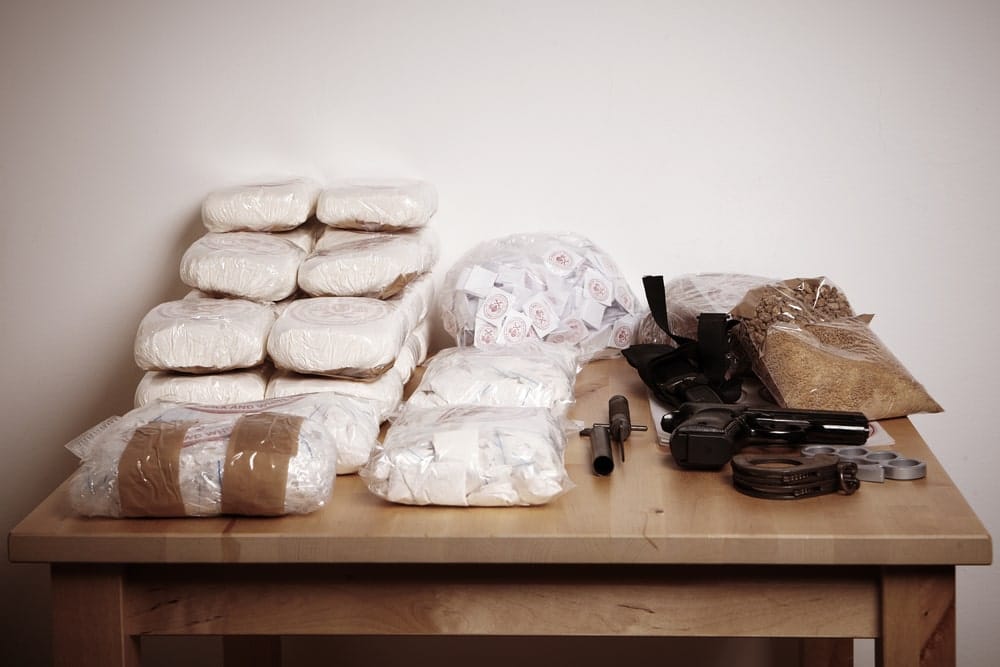


If you are convicted of a drug crime in Maine, your sentence will depend on four main factors: the type of drug involved (classified into four schedules), the amount of the drug possessed, the nature of the activity (e.g., possession, trafficking, manufacturing), and your criminal history.
Other factors may be considered and can elevate or reduce the penalties. Either way, however, the sentence is likely to be severe, especially if other factors aggravate the crime and require judges to impose a mandatory minimum sentence.
Let us take a closer look at what you can expect from criminal drug charge sentencing in Maine.
Drug schedules in Maine
In Maine, drugs schedules are split into four different categories that help to determine the severity of the crime charged:
- Schedule W drugs are considered the most serious and include heroin, cocaine, oxycodone, and methamphetamine.
- Schedule X drugs include hallucinogens like psilocybin (mushrooms) and hashish.
- Schedule Y drugs include certain prescription drugs like codeine and diazepam.
- Schedule Z drugs are considered the least serious and include any drugs not categorized above.
Drug sentencing in Maine
There are five classifications of drug crimes in Maine. The maximum period of incarceration and fine for a drug crime will depend on its classification, as follows:
- Class A crime: a felony punishable by up to 30 years in prison and a $50,000 fine.
- Class B crime: a felony punishable by up to 10 years in prison and a $20,000 fine.
- Class C crime: a felony punishable by up to 5 years in prison and a $5,000 fine.
- Class D crime: a misdemeanor punishable by up to one year in jail and a $1,000 fine.
- Class E crime: a misdemeanor punishable by up to 6 months in jail and a $500 fine.
Class D and E drug crimes (misdemeanors) are served in county jail and Class C, B, and A drug crimes are served in state prison.
In most cases, Judges can exert some discretion with sentencing, but certain classes of drug crime attract mandatory minimum sentences that must be applied unless there are exceptional circumstances.
The mandatory minimum drug crime penalties are:
- Class A felony: 4 years in prison
- Class B felony: 2 years in prison
- Class C felony: 1 year in prison
- Aggravated drug trafficking: 1 year in prison
- Class C felony related to trafficking marijuana: up to 1 year in prison

The most common drug charges in Maine
Drug possession and trafficking are among the most common drug charges in Maine. Trafficking, as defined under MRS 17-A § 1101(17), involves the sale, distribution, or intent to distribute illegal drugs. This can include activities such as exchanging drugs for money or goods, transporting drugs for sale, or possessing large quantities indicative of distribution. Trafficking charges often carry severe penalties, including substantial fines and lengthy prison sentences, depending on factors like the type and amount of drugs involved, prior offenses, and whether minors were affected.
Investigations are usually conducted by law enforcement, often using information from informers. A simple drug possession charge can escalate to a trafficking offense relatively easily depending on the amounts involved.
Let us take a closer look at the main drug charges.
Unlawful Possession of Scheduled Drugs in Mane
Title 17-A, §1107-A contains the various crimes which fall under the general category of unlawful possession of schedules drugs. Under the rules of this section, a person is guilty of unlawful drug possession when they intentionally or knowingly possess a substance which they know or have reason to believe is a scheduled drug.
If the offender possesses a schedule W drug and has a prior offense, then the crime may be categorized as a class C crime. If a person possesses a schedule W drug and the amount is sufficient, then the crime may be a class B crime. Possession of a schedule X drug is ordinarily a class D crime. Possession of a schedule Y or Z drug is ordinarily a class E crime.
Maine law has specific rules for the possession of marijuana, in part because medical marijuana is legalized, and because marijuana is among the most commonly used drugs. So, although simple possession of marijuana is a class E crime, certain factors can alter this classification.
For instance, if a person possesses more than 20 pounds of marijuana, this offense will be treated as a class B crime, and can be punished accordingly.
Allegations of possession can be countered with certain defenses in Maine, and these defenses are also referenced under this section.
“For example, a defense against possession of marijuana is that the substance is actually hemp. Similarly, if a person can prove that a certain drug is authorized by a legitimate medical prescription, this may also constitute a defense.”
Marijuana possession and cultivation in Maine
Because medical and recreational marijuana is legal in Maine, marijuana possession and cultivation have their own set of laws and penalties:
- Possession of 2.5 to 8 ounces of marijuana: Class E misdemeanor
- Possession of 8 ounces to 16 ounces (one pound) of marijuana: Class D misdemeanor
- Possession of one pound to 20 pounds of marijuana: Class C felony
- Possession of over 20 pounds of marijuana: Class B felony
Classification for marijuana cultivation depends on the number of plants grown and is as follows:
- Fewer than 5 marijuana plants: Class E crime
- Between 5 and 100 marijuana plants: Class D crime
- Between 100 and 500 marijuana plants: Class C crime
- 500 or more marijuana plants: Class B crime
Unlawful Trafficking in Scheduled Drugs in Maine
Trafficking drugs is also a crime under Maine law. This type of crime is governed by Title 17-A, §1103-A. Essentially, drug trafficking occurs whenever someone intentionally and knowingly sells illegal drugs.
As with drug possession offenses, the severity of a drug trafficking penalty in Maine ultimately depends on several factors, including the seriousness of the drugs, the quantity of the drugs, and so forth. In fact, under current Maine law, the quantity of drugs may actually provide grounds for an inference of drug trafficking, even without other evidence.
For instance, if a person is caught with more than 1 pound of marijuana, this may provide grounds for an inference of trafficking.
A drug trafficking offense can also be exacerbated by certain factors. Exacerbating or aggravating factors include things such as selling scheduled drugs to a minor and selling near a school or drug free safe zone.
Incidentally, if a person uses a motor vehicle in the process of committing a drug trafficking offense, this can also lead to additional consequences. For example, the court could order that the car be forfeit as part of a criminal forfeiture action brought by the government.
Illegal drug importation in Maine
One of the main drug trafficking charges is the illegal importation of prohibited drugs, i.e., carrying drugs into Maine from another state. Importing a Schedule X, Y or Z drug is a Class C felony while importing a Schedule W drug is a Class B felony.
The drug charge can be elevated if certain aggravating circumstances apply. These include if the offender has prior drug offense convictions, he/she possessed a firearm, a large amount of the drug is imported (e.g., over 6 grams of heroin), death resulted from the activity or children were involved in the commission of the crime.
For instance, illegally importing a Schedule W drug into Maine by an offender with a prior conviction for illegal drug importation can see the crime elevated from a Class B to a Class A felony. If the offender possessed a firearm during the commission of the illegal drug importation of a Schedule W drug, the offense may also be elevated to a Class A felony. Similarly, if a child was solicited during the commission of the crime, the outcome may be a Class A felony conviction.
Drug Paraphernalia Crimes in Maine
Title 17-A, §1111-A contains “drug paraphernalia” offenses in Maine. Residents are prohibited by law from possessing certain drug paraphernalia which could be used in the manufacture or consumption of illicit drugs.
The following are examples of illegal paraphernalia in Maine:
- bongs,
- roach clips,
- syringes,
- marijuana pipes,
- scales and others.
This type of offense is considered a civil offense, unless the offender is “trafficking” in paraphernalia to someone 16 years of age or older, which is considered a Class E crime, or under the age of 16, which is considered a Class D crime.
One important thing that readers should take away is that drug paraphernalia may also provide grounds to execute a search on a person’s motor vehicle or home if the police are there lawfully and the paraphernalia is in plain view.
By law, if a person is stopped by a police officer, that officer may not conduct a search of the vehicle unless the motorist gives express permission, or unless the officer has adequate grounds. Adequate grounds essentially means a reasonable suspicion that the motorist possesses illegal substances.
If a person is caught with drug paraphernalia, then this may provide reasonable suspicion for a larger search, and that search may uncover other illegal substances.
What determines whether a drug charge will be a misdemeanor or felony in Maine?
To recap, the main factors determining whether a drug crime is regarded as a misdemeanor or felony in Maine are:
- The type of drug involved
- The quantity of the drug in question
- The specific circumstances of the alleged offense (e.g., whether a child was involved, a school was nearby or a firearm was used)
- The criminal history of the defendant
The best way to avoid the types of drug charge sentencing outlined above is to seek seasoned legal assistance if you face drug crime charges in Maine.
Possible Defenses to Drug Crimes in Maine
Numerous possible defenses may be raised to a drug crime allegation. The viability of any given defense depends on the specifics of the case. Here is a brief list of possible defenses:
- Miranda warnings were not read
- There was no probable cause for an arrest
- The initial stop conducted by police was unlawful
- The search which uncovered drugs was unlawful
- The drugs were never constructively or actually possessed
- The defendant was unaware that the substance was an illegal drug
- The elements of the crime are not fully met
- The defendant was holding drugs under duress / coercion at the direction of another person
Contact the Maine Criminal Defense Group Today
Maine law in the area of drug crime will almost certainly continue to evolve and change in the future. Based on current trends, we can likely expect that certain drug crimes may be either reduced in severity or eliminated altogether.
For now, we are stuck with the current paradigm. Maine residents who commit one of these offenses can expect a charge, and the charge will depend on the relevant factors – seriousness of the drug itself, number of prior convictions, etc.
If you’ve been accused of a drug related crime in Maine, you need the benefit of an experienced criminal defense team. You don’t want to risk a conviction, as we’ve seen the fact that convictions can lead to very serious punishments.
If you’re accused of a felony drug crime, for instance, a conviction can damage your career by giving you a blemished record, and even impact child custody decisions.
You need a group of attorneys who can help provide the best possible defense.
Related Articles